 RigMining
Mining basics
Bitcoin Halving Explained: What It Means for Miners
What the Bitcoin halving is, when the last and next ones happen, and why smaller block rewards make machine efficiency and power cost matter more.
What the halving is
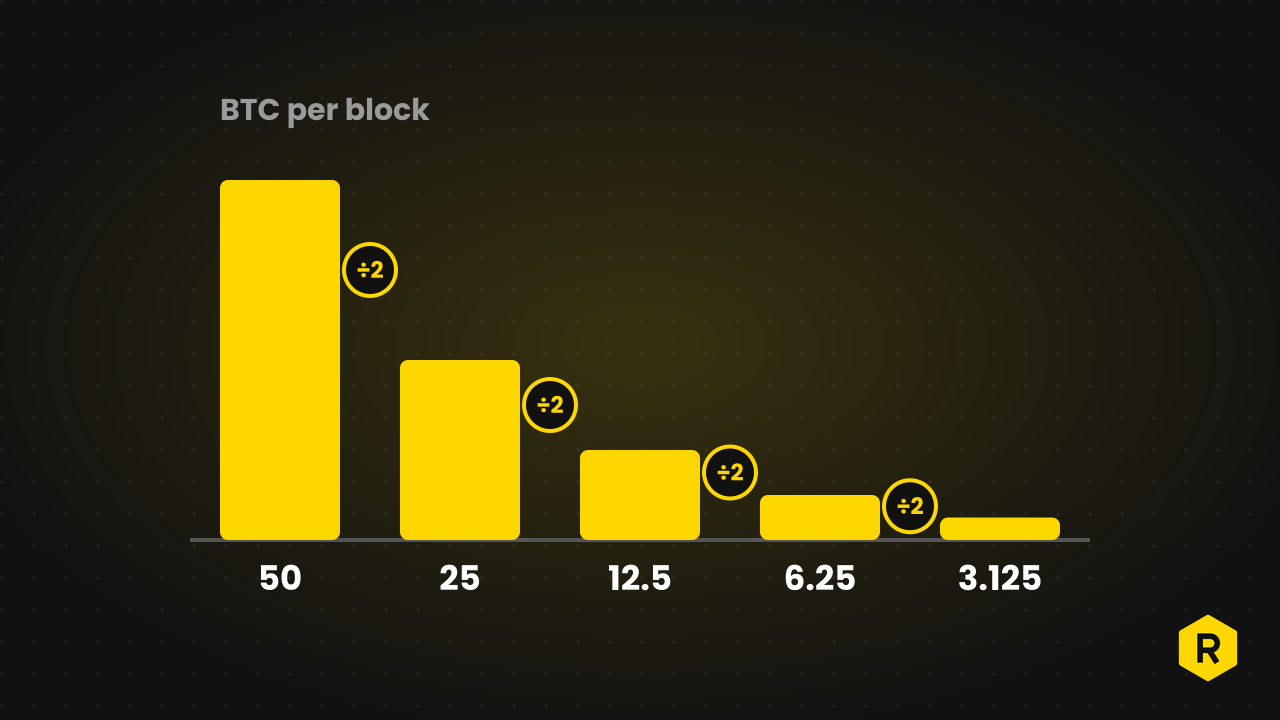
Every time miners add a block, the network creates some new bitcoin and pays it to them. This payment is the block subsidy. Bitcoin’s rules cut the subsidy in half after every 210,000 blocks. Because a block arrives about every 10 minutes, that works out to roughly every four years.
No company or person decides this. It is part of Bitcoin’s design, and it is why new bitcoin is created more slowly over time.
The schedule
| Halving | Block number | Date | Subsidy after |
|---|---|---|---|
| First | 210,000 | November 2012 | 25 BTC |
| Second | 420,000 | July 2016 | 12.5 BTC |
| Third | 630,000 | May 2020 | 6.25 BTC |
| Fourth | 840,000 | April 2024 | 3.125 BTC |
| Fifth | 1,050,000 | Expected around April 2028 (an estimate) | 1.5625 BTC |
Bitcoin started with a subsidy of 50 BTC per block in 2009.
Why the next date keeps moving
Blocks do not arrive at exactly 10 minutes. When more machines join the network, blocks come a little faster until the difficulty catches up, and the expected date moves earlier. When machines leave, it moves later. Trackers use slightly different methods, so you will see dates a few weeks apart.
The reliable fact is the block number: the next halving happens at block 1,050,000. The calendar date is a projection until the network gets close.
What it means in numbers
At about 144 blocks a day:
- With a 3.125 BTC subsidy, the network creates about 450 BTC a day in subsidies (3.125 × 144).
- After the next halving, with 1.5625 BTC, that falls to about 225 BTC a day.
Transaction fees are on top of this, and they vary with demand for block space.
What it means for a miner
When the subsidy is cut in half, the same machine earns about half as much subsidy, unless something else changes. Three things can offset it:
- A higher Bitcoin price, which makes each reward worth more in dollars.
- Higher transaction fees.
- Lower difficulty, which happens if less hashrate is competing for blocks.
Nobody can tell you in advance which of these will happen, and we do not predict the Bitcoin price. What we can say is that a halving squeezes margins, so two things matter more afterwards: efficiency (less electricity per terahash) and power price. See how to read a spec sheet and what drives profitability.
What happens in the long run
The subsidy keeps halving until it reaches zero, around the year 2140. After that, miners will be paid from transaction fees alone.
A simple check before you buy
If you plan to keep a machine for several years, the next halving falls inside that time. A cautious test:
- Estimate your daily earnings today with a calculator.
- Halve the revenue (a rough stress test, since fees do not halve).
- Check whether the machine still covers its power cost and still pays back at a pace you accept.
OneMiners’ Bitcoin mining calculator asks for your hashrate, power draw, electricity price and pool fee, so you can run this test with your own numbers. The miner profitability table compares machines at a power rate you choose. If you are new to the tools, start with our tutorial on using the Bitcoin mining calculator.
Sources and further reading
Written by the OneMiners team. We sell and host mining machines, so this article links to our own pages where they are relevant, and the sources above are independent. It explains how things work and is not financial advice. Mining carries risk, and prices, rates and features change, so check oneminers.com for current details.