 RigMining
Coins
Alephium (ALPH) Mining Explained: Blake3, 16 Chains and the Lock Period
Alephium is a proof-of-work network with 16 chains and Blake3 mining. See how it works, why mined coins are locked for a while and what to check before buying.
What Alephium is
Alephium (ALPH) is a proof-of-work cryptocurrency that also supports smart contracts. A Kryptex glossary entry on the coin says it launched in 2021, uses the Blake3 algorithm, and has ASIC miners available. The project calls its approach to consensus Proof-of-Less-Work.
Blake3 can also be mined on graphics cards, so Alephium is not an ASIC-only coin. If you want a dedicated machine, check that the listing names Blake3. Our guide to which coins an ASIC can mine explains why an ASIC only works for the algorithm it was built for.
Sixteen chains instead of one
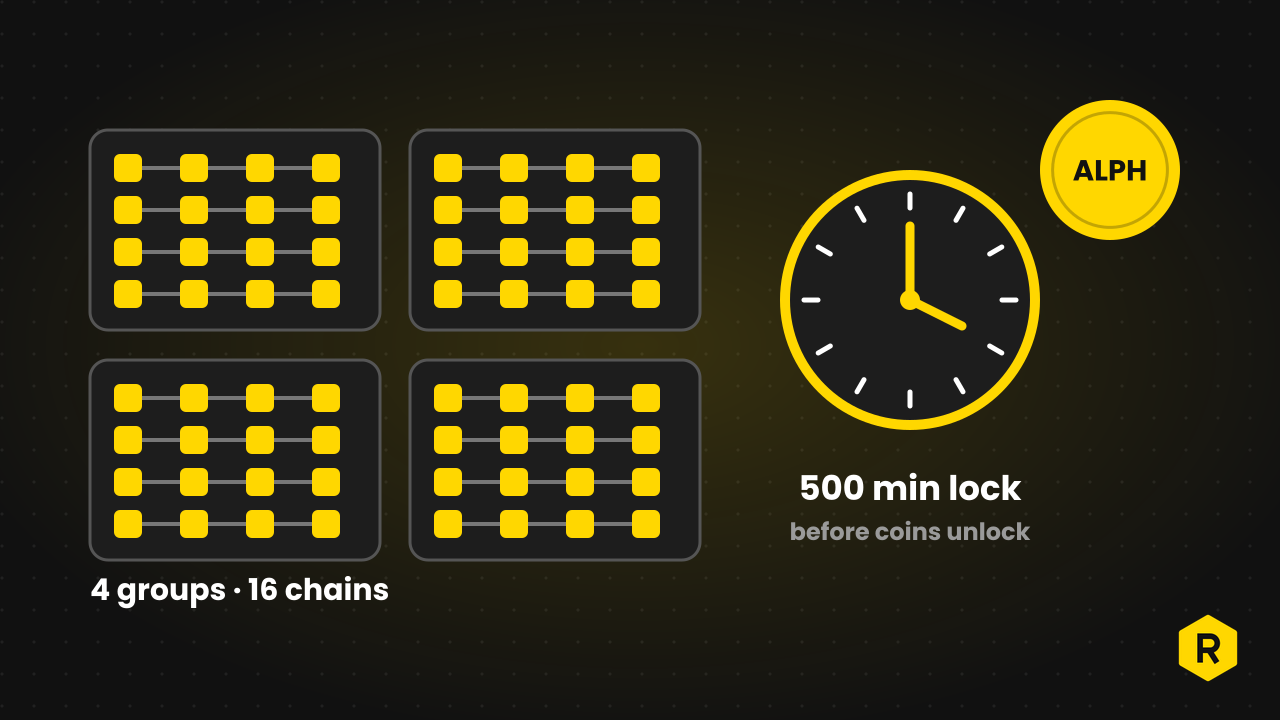
The Alephium documentation says the network currently has four address groups and sixteen chains. Instead of one long chain of blocks, the network runs many chains side by side, and miners work on all of them.
Two numbers from the same page help to picture the pace:
- The target time for a block is 8 seconds.
- On average about 172,800 blocks are mined per day across the network. That is sixteen chains with a block roughly every 8 seconds each.
The block time has changed before. The project’s own post on block rewards explains that it started at 64 seconds, dropped to 16 seconds with the Rhône upgrade in 2024, and dropped again to 8 seconds with the Danube upgrade in July 2025. Older articles may still quote the old figures. When you read about a coin, look at the date and compare it with the project’s current documentation.
Mined coins are locked for a while
The Alephium documentation states that mined coins are locked for 500 minutes, which is a little over eight hours. This is a feature of the network, so every miner and every pool deals with it.
What this means for you:
- A reward does not become spendable the moment it is earned.
- A pool may show earnings before they can be moved. Read the pool’s page to see when it pays out.
- Do not plan to spend or sell the coins on the same day they are mined.
Pools and solo mining
The documentation says you can mine in a pool or solo. Solo mining means you only earn when your own machine finds a block, so income can be very uneven. A pool shares rewards among its members, which smooths income. Our article on pool payouts explains the common payout methods.
Before you choose a pool, check that it supports ALPH, what it charges and when it pays.
What to check before you buy an Alephium miner
- The algorithm. The listing should say Blake3.
- Hashrate and unit. Machines are listed in TH/s. Compare like with like.
- Power draw and efficiency. Electricity is the biggest running cost, so see how to read a spec sheet.
- A pool that supports ALPH. Read its fee and payout rules.
- The lock period. Make sure you can wait for coins to unlock before you plan to use them.
- The project’s plans. Block times and rewards have changed through upgrades. Read the latest announcements before you commit.
- Your own numbers. Use the calculator with your power price. It gives an estimate, not a promise.
Where to look on OneMiners
The Alephium miners collection lists the machines OneMiners sells for this coin, with filters for brand, hashrate and energy efficiency. OneMiners also keeps a manuals and firmware library for the models it sells. The calculators page lets you test your own electricity price.
If a term here is new to you, the glossary explains the words used on OneMiners.
Sources and further reading
Written by the OneMiners team. We sell and host mining machines, so this article links to our own pages where they are relevant, and the sources above are independent. It explains how things work and is not financial advice. Mining carries risk, and prices, rates and features change, so check oneminers.com for current details.